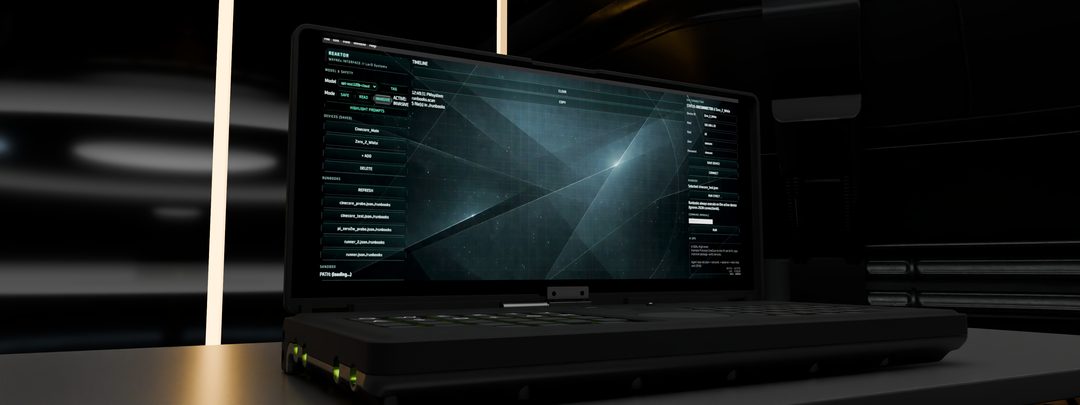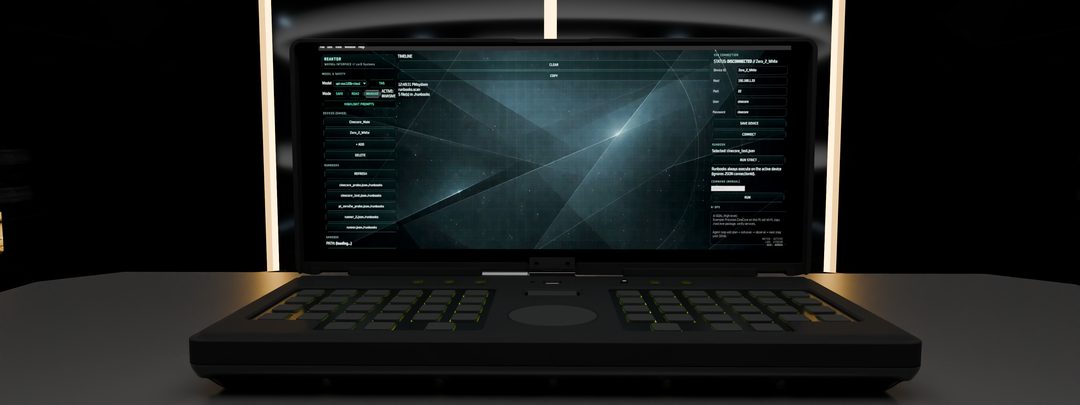
AI-assisted remote operations for microcomputers and edge nodes.
Reaktor connects over SSH and performs real-world configuration tasks: provisioning, hardening,
deployment, updates, recovery and repeatable rollout — across a fleet.
Offline/LAN ready. Designed for controlled environments, institutional deployments, and field operations.
Reaktor SSH is a product that uses AI to execute infrastructure work on microcomputers remotely. Not a dashboard. Not a toy. It does real operations through SSH, with controlled policies and repeatable procedures.
Reaktor performs multi-step tasks through SSH: execute → observe → correct → finalize. This makes it perfect for provisioning edge devices, micro-servers, kiosks, and embedded deployments.
Fleet operations fail when tasks are manual, inconsistent, and hard to audit. Reaktor turns that into a controlled process.
Each node is configured “by hand” and becomes unique. That kills scale.
Small differences in commands and order cause drift and random failures.
Without clean logs, you can’t prove what happened on the device.
Standardize provisioning and deployments across the fleet.
Execute tasks iteratively, reacting to real command outputs.
Defined permissions, action boundaries, and operational logs.
Reaktor is a backbone tool for any deployment built on microcomputers and edge nodes.
The workflow is simple: connect → execute tasks → validate outputs → report status. Reaktor is designed to behave like a disciplined operator — not a “chat app”.
Secure SSH access, keys, identity and environment selection.
Multi-step ops: install, configure, deploy, restart, validate.
React to real outputs: errors, logs, prompts, service states.
Status summary, logs, and predictable handover for the client.
Reaktor is most powerful when used to standardize your fleet: same baseline, same steps, same verification. It reduces operational risk and speeds up real deployments.
Reaktor can operate inside restricted networks. Actions can be bounded by permissions and client policy.
Tell us your target devices (microcomputers/edge nodes), network constraints (offline/LAN), and operational goals. We’ll respond with a technical briefing and deployment proposal.